Gender stereotypes may possibly be most visible in advertisements for cleaning products and food items, especially restaurants. Fast food restaurants such as Carl's Jr. predominantly employ attractive, skinny, white women in their campaigns. A quick Google search of "Carl's Jr. Ads" brings up pages and pages of images of women in bikinis eating Carl's Jr. burgers. The disconnect is obvious: why are these women, dressed as they are, eating burgers in sexual postures? Obviously the ads are working because sex sells but they are effective because they reduce women to being sexual objects juxtaposed with a product.
On the household side, ads for appliances or cleaning products generally tend to depict women who desire to purchase them so that they can clean and maintain the home. For instance, this Bosch appliances advertisement shows the evolution of their appliances between the years 1886 and 2011. What is interesting is that instead of showing a male in the most recent ads, the company decided to show women standing next to their appliances which reinforces the notion that women were responsible for household chores in the 1880s and still are today.
Friday, February 27, 2015


Thursday, February 26, 2015
Post 4 (or, the issue of stereotypes in advertising)
Is it ever right to racially stereotype for advertising purposes?
Simply, no. If you have to resort to stereotypes to sell your product you need a new advertising agency or a better product. By using race or stereotypes as a platform to sell an item I think it reduces the credibility of the product being sold and undermines its quality.
Is racism in advertising a thing of the past?
Clearly it is not. Recent advertisements -- some of which we have seen in class -- clearly demonstrate that racism in advertisement is prevalent. For instance, this recent Ralph Lauren advertisement used images of Native Americans dressed in RL clothes. The cultural insensitivity of taking photos of Native Americans whose people faced genocide and prejudice and applying them to fashion is appalling and undermines the attitudes of Americans during the time the photos were taken.
Celine Cooper writes:
"Native American children were forcibly sent to boarding schools and prohibited from speaking their own languages. Traditional practices were forbidden. Many government policies of assimilation were enforced through threats of violence and imprisonment."
Do advertisers have ethical responsibilities?
I would say so. Mass media messages are being sent out to people in all corners of the country and the world so it would be asinine to assume that anything could be broadcast without repercussion. Advertisers have the ability to persuade the pubic and shape culture and thus should be aware of the implications in their messages.
Tuesday, February 17, 2015
Post 3 (or, I'm doing a semiotic analysis of 3 ads)
TV Commercial:
Denotation:
Print Ad:
Heinz Plant Bottle:
Denotation:
Outdoor Ad:
IBM, Smarter Cities
Denotation:
- Rob Lowe is seated in a studio and introduces himself, explaining that he has DirecTV.
- He is holding a cup of coffee and wearing a suit. He is clean shaven and sports a clean haircut.
- Then "Super Creepy Rob Lowe" walks into the frame and introduces himself and tells the audience that he has cable.
- Super Creepy Rob Lowe is dressed in a leather jacket, has a bit of a gut, and is wearing jeans. He has a mustache and slicked back hair.
- Super Creepy Rob Lowe then caresses normal Rob Lowe's shoulder.
- In the next scene, Rob Lowe is sitting in bed watching TV and explaining DirecTV's reliability.
- Cut to Super Creepy Rob Lowe and he is sitting poolside at a public rec center. He explains that his cable is out and so he resorts to watching people swim.
- Cut back to normal Rob Lowe still in bed but this time sipping a warm drink.
- Next, cut to Creepy Rob Lowe in a movie theater telling the TV audience that he loves the smell of people's hair as he sniffs the hair of the woman in front of him.
- The next cut zooms out and portrays Rob Lowe standing in his suit next to his creepy counterpart and he implores the audience to not be creepy and get DirecTV instead.
- The last image on the screen is the pricing, contract, and customer service information
- Rob Lowe's initial appearance in his suit indicates a classy individual, perhaps a professional
- The studio background is used as a means to trick the audience into believing that this commercial is meta, or not a typical commercial.
- Creepy Rob Lowe's dress and mannerisms are indicative of an individual you may not want to meet. He is more laid back than the suited up Rob Lowe.
- When Super Creepy Rob Lowe caresses Rob Lowe's shoulder, the message being conveyed is that those who have cable are creeps or perverts; dress poorly, and are generally people you don't want to meet whereas DirecTV viewers are sophisticated, in shape, handsome, and dress well.
Print Ad:
Heinz Plant Bottle:

Denotation:
- Red bottle facing viewer, has sticker with company name, black text, plant bottle logo, weight information
- Bottle has a white cap on the bottom
- A green tomato vine is connected to the bottle cap
- Ad copy to the right of the bottle with supplemental information in the bottom right
- Plant bottle logo and recycling information
- logo of tomato on vine in bottom right which reads "grown not made"
- White background
- The red bottle replaces a tomato on a vine to imply that it is natural
- It involved word play with the copy, "plant one on every table" by connecting the bottle to the tomato plant
- This also implies that not only is the bottle 'natural' or 'organic' in a sense but also that the ketchup is made from natural tomatoes
- The bottle is meant to be recycled and is made of recycled material
Outdoor Ad:
IBM, Smarter Cities
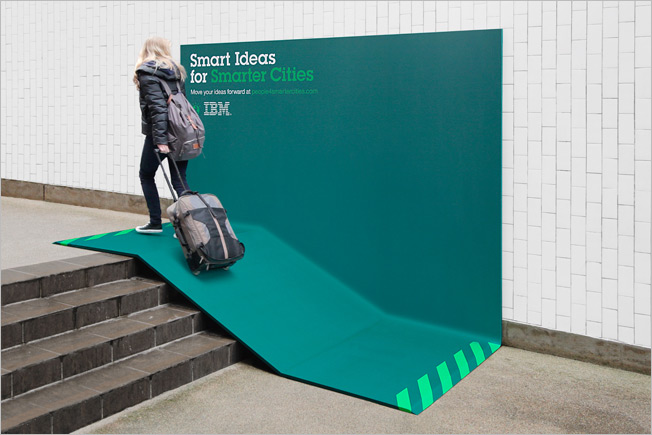
Denotation:
- Concrete steps in the foreground
- Woman wearing gray backpack, black jacket and dark blue jeans
- She is hauling a gray and black suitcase
- She is walking up a green/blue ramp that has been placed over a portion of the steps
- The ramp has a vertical wall portion which rests against the building
- The words "Smart Ideas for" in white at the top left corner of the vertical portion
- The words "Smarter Cities" in green following the white text
- There is copy text under the slogan in white and then in green
- The logo is below the copy text in white
- The ramp has green angled marks at both ends where visitors can step on/off of it
- The ramp is placed over steps which shows that the product is trying to fix the problems with living in cities
- The ramp appears to be a metaphor for smoothing transitions between one space and another and also as an aim to tackle social issues
- The colors of the ramp stand out from the stark gray of the building and concrete which is meant to mean that it isn't an invisible service or product but integral to people's lives
Friday, February 6, 2015
Post 2 (or, why I'm choosing Bud Light's "Up for Whatever" Super Bowl commercial)
For this post I am choosing the Budweiser "Pacman Up For Anything" advertisement. The ad continues the "Up for Whatever" campaign wherein a supposedly unwitting patron becomes the center of an eventful evening which follows an ever more outrageous sequence of events. This year's Super Bowl commercial follows a similar vein to that of last year's wherein a man, Ian, is offered a Bud Light but only on the condition that he agrees to engage in whatever happens next and is part of a broader campaign which positions Bud Light as the beer for young people that live spontaneous, exciting lives. The implication, and thus the message, being that Bud Light is a beer for those who enjoy taking chances and "living life to the fullest," so to speak.
Previous commercials have featured celebrities who appeal to Bud Light's campaign demographic although this particular ad eschews celebrities for nostalgia. A good chunk of the commercial is the game of life-size Pacman our protagonist unwittingly agrees to. This is a clever move because not only is the production of the commercial from a technical standpoint interesting but the game appeals to a wider audience and represents the younger generation's interests.
The choice to air this continuation during the Super Bowl is a logical one. It is part of our culture to watch sports games with friends and to partake in the consumption of alcohol and the Super Bowl is sort of a last hurrah wherein households hold Super Bowl parties and alcohol is a major factor of these parties. So, what Budweiser is doing is not only positioning its brand as a beer for young people who like to have fun and take risks but also as a beer for sports fans in the hope that when the next sports season starts up, it will be Budweiser's products that fans are drinking.
Previous commercials have featured celebrities who appeal to Bud Light's campaign demographic although this particular ad eschews celebrities for nostalgia. A good chunk of the commercial is the game of life-size Pacman our protagonist unwittingly agrees to. This is a clever move because not only is the production of the commercial from a technical standpoint interesting but the game appeals to a wider audience and represents the younger generation's interests.
The choice to air this continuation during the Super Bowl is a logical one. It is part of our culture to watch sports games with friends and to partake in the consumption of alcohol and the Super Bowl is sort of a last hurrah wherein households hold Super Bowl parties and alcohol is a major factor of these parties. So, what Budweiser is doing is not only positioning its brand as a beer for young people who like to have fun and take risks but also as a beer for sports fans in the hope that when the next sports season starts up, it will be Budweiser's products that fans are drinking.
Budweiser, "Pacman Up For Anything"
Subscribe to:
Posts (Atom)